

Key Takeaways
- Core ingredients: butter, powdered sugar, flour, and vanilla — the base for all nine recipes
- Most important rule: use cold butter and don’t overwork the dough; both affect texture significantly
- Chill time: 30–60 minutes for most recipes to prevent spreading and improve shape retention
- Baking temperature: 325°F–350°F — shortbread bakes low and slow compared to other cookies
- Doneness sign: pale golden edges with a matte (not shiny) surface; the centers should not brown
- Make-ahead friendly: dough logs freeze for 3 months; baked cookies keep 2 weeks in an airtight tin
- Best occasion: holiday cookie trays, gift tins, cookie swaps, afternoon tea, and Christmas gifting
Introduction

Christmas Shortbread Cookies are the kind of holiday baking project that feels manageable even when December is already overwhelmingly full. The base dough uses four ingredients, comes together in about ten minutes, and produces cookies that taste buttery, delicate, and genuinely impressive without requiring any decorating skills or specialty equipment.
The challenge most people face with shortbread is getting the texture right. Too much mixing develops gluten and turns the cookies tough; too much butter makes them greasy and crumbly; the wrong temperature produces cookies that spread into flat, thin discs. This guide addresses all of that directly. Nine recipe variations build on the same dependable base, each with a different flavor or decoration direction — from a simple classic butter version to a peppermint white chocolate version that belongs on every holiday tray.
Whether you’re baking for a cookie exchange, filling gift tins for neighbors, or just want the house to smell like brown butter and vanilla on a December afternoon, these nine recipes will cover every occasion.
What You’ll Need
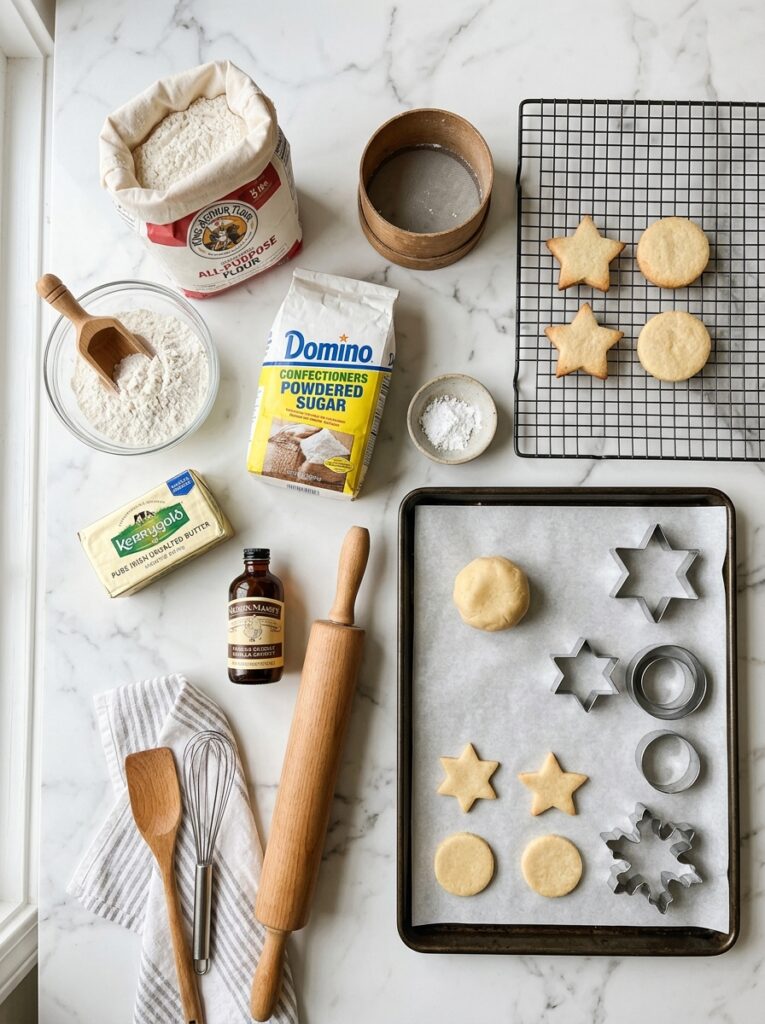
Equipment
- Stand mixer or hand mixer — for creaming butter; a fork and elbow grease also works
- Rolling pin — for rolled and cut shortbread varieties
- Cookie cutters — Christmas-themed shapes for the decorated versions
- Rimmed baking sheet — light-colored aluminum produces more even baking than dark pans
- Parchment paper — essential; shortbread is delicate and sticks to unlined pans
- Wire cooling rack — shortbread needs air circulation while cooling to keep the base from getting soggy
- Plastic wrap — for wrapping chilled dough logs
Shared Base Ingredients
- Unsalted butter — use good quality; shortbread has nowhere to hide inferior fat
- Powdered sugar — gives a more tender texture than granulated sugar
- All-purpose flour — measure by spooning into the cup and leveling off, not scooping directly
- Vanilla extract — pure vanilla, not imitation; it matters more in a simple dough
- Salt — a small amount balances the sweetness and amplifies the butter flavor
Recipe 1: Classic Butter Shortbread
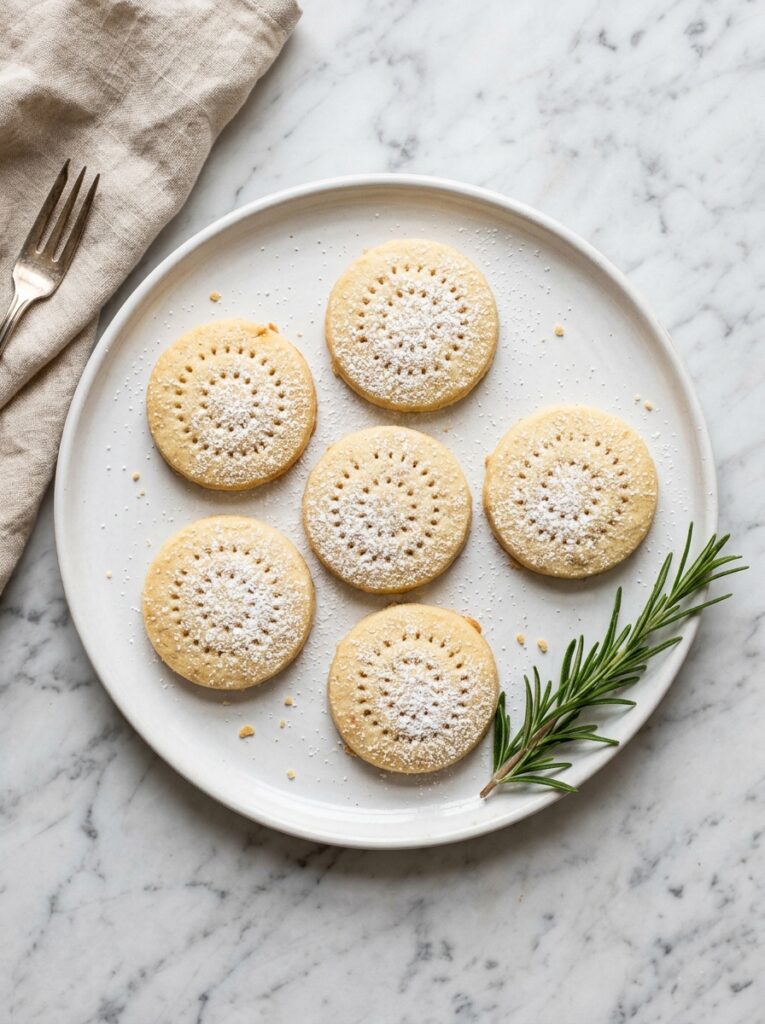
This is where every shortbread journey should start. Just butter, powdered sugar, flour, vanilla, and a pinch of salt — nothing else. The result is a pale, buttery cookie with a melt-in-the-mouth crumb that tastes clean, rich, and understated in the way that only a truly simple recipe can. Once you’ve nailed this base, all eight variations make intuitive sense.
Ingredients
- 1 cup unsalted butter, cold and cut into cubes
- ½ cup powdered sugar, sifted
- 2 cups all-purpose flour
- 1 teaspoon vanilla extract
- ¼ teaspoon salt
Instructions
- Beat cold butter and powdered sugar together until just combined and smooth — about 1 minute. Don’t overbeat; you want the mixture combined, not fluffy.
- Add vanilla and salt, then mix briefly. Add the flour all at once and mix on low until the dough just comes together into a ball. Stop as soon as it’s cohesive.
- Flatten into a disc, wrap in plastic, and refrigerate for 30 minutes.
- Preheat oven to 325°F. On a lightly floured surface, roll the dough to ¼-inch thickness. Cut into rounds or desired shapes and place on parchment-lined baking sheets.
- Prick each cookie several times with a fork to prevent puffing, then bake for 14–16 minutes until the edges are just barely golden and the surface looks matte. Cool completely on the pan before moving.
In my experience, cold butter rather than softened butter produces a noticeably crisper, more defined shortbread. Softened butter makes the dough easier to work with but the final texture is softer and less distinct. For shortbread specifically, cold butter is worth the slight extra effort.
Recipe 2: Chocolate Dipped Shortbread
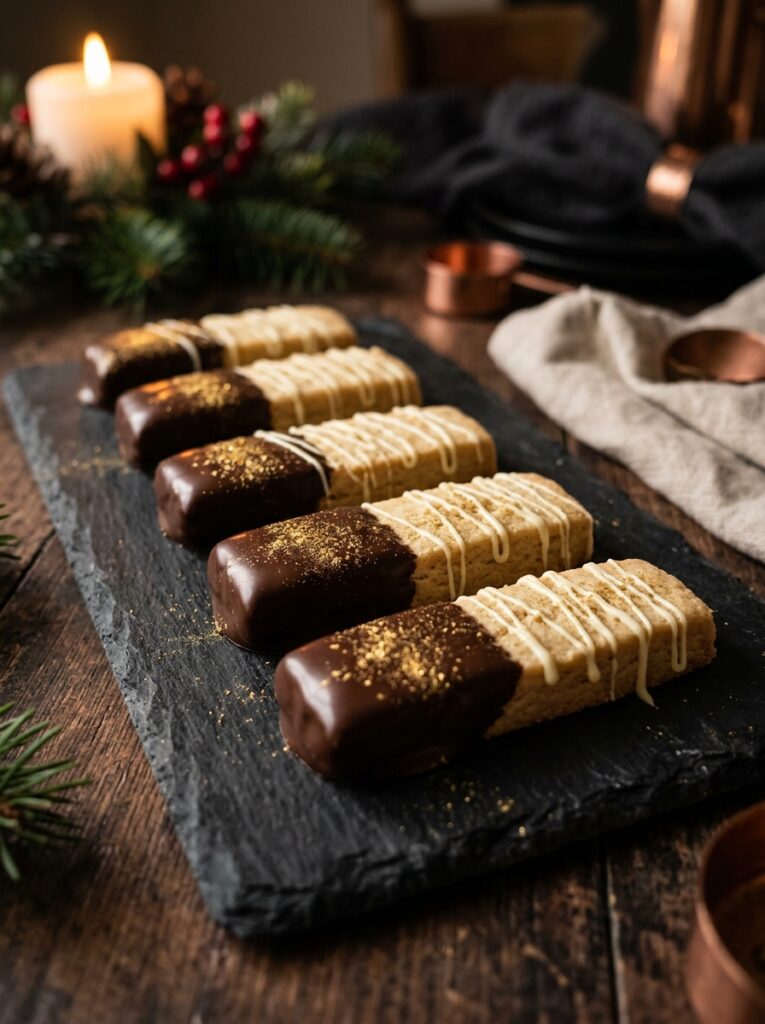
The classic recipe with one finishing step that transforms it entirely. After baking, each shortbread finger gets dipped halfway into melted dark chocolate, set on parchment, and finished with a white chocolate drizzle. The combination of buttery shortbread and bittersweet chocolate produces a cookie that feels sophisticated without requiring anything beyond the base recipe and a few minutes of decorating time.
Ingredients
- 1 batch Classic Butter Shortbread dough (see Recipe 1), shaped into fingers
- 6 oz dark chocolate (60–70% cocoa), roughly chopped
- 1 tablespoon coconut oil (for thinning the dipping chocolate)
- 2 oz white chocolate, melted (for drizzle)
- Flaky sea salt or sprinkles for finishing (optional)
Instructions
- Prepare and bake the shortbread shaped into rectangular fingers (about 1×3 inches). Cool completely before dipping.
- Melt dark chocolate and coconut oil together in a microwave-safe bowl, stirring every 30 seconds, until smooth and glossy.
- Dip the bottom half of each cooled shortbread finger into the melted chocolate. Let the excess drip off, then lay flat on a parchment-lined sheet.
- While the dark chocolate is still wet, add a pinch of flaky sea salt if using.
- Once all cookies are dipped, melt the white chocolate and drizzle it across the dark chocolate layer in a zigzag motion using a fork or piping bag.
- Let set completely at room temperature — about 30 minutes — before stacking or storing.
Recipe 3: Lemon Glazed Shortbread

Lemon cuts through the richness of butter in a way that makes these shortbread cookies taste lighter than the classic while still delivering the same satisfying crumb. Lemon zest goes directly into the dough, and a simple lemon icing — powdered sugar and fresh lemon juice — finishes each cookie with a glossy, slightly tart coat that sets firm within twenty minutes. These are consistently the most popular variation on a holiday tray for anyone who finds pure butter cookies too rich.
Ingredients
- 1 cup unsalted butter, cold, cubed
- ½ cup powdered sugar
- 2 cups all-purpose flour
- Zest of 2 lemons
- 1 teaspoon vanilla extract
- ¼ teaspoon salt
For the lemon glaze:
- 1½ cups powdered sugar
- 3–4 tablespoons fresh lemon juice
- Yellow food coloring (optional — 1–2 drops)
Instructions
- Mix cold butter and powdered sugar until just combined. Add vanilla, lemon zest, and salt. Then add flour and mix until the dough just comes together.
- Wrap and refrigerate for 30 minutes. Meanwhile, make the glaze by whisking powdered sugar with lemon juice until smooth and pourable. Add food coloring if desired.
- Preheat oven to 325°F. Roll dough to ¼-inch thickness, cut into stars or rounds, and place on parchment-lined baking sheets.
- Bake for 14–16 minutes until edges are just barely golden. Cool completely before glazing.
- Dip or spoon glaze over each cookie and spread to the edges with a small offset spatula. Let cookies rest on a rack for 20–30 minutes until the glaze sets completely.
Recipe 4: Cranberry Orange Shortbread

Dried cranberries and orange zest folded directly into the dough give these shortbread cookies a naturally festive look without any extra decoration. The tart cranberry pieces and bright citrus zest break up the richness of the butter in every bite. Since both mix-ins are stirred in before chilling, this recipe requires minimal extra work compared to the classic — it’s the same process with two additions that completely change the flavor.
Ingredients
- 1 cup unsalted butter, cold, cubed
- ½ cup powdered sugar
- 2 cups all-purpose flour
- Zest of 1 large orange
- 1 teaspoon vanilla extract
- ¼ teaspoon salt
- ½ cup dried cranberries, roughly chopped if large
- Powdered sugar for dusting
Instructions
- Beat cold butter and powdered sugar until just combined. Add vanilla, orange zest, and salt.
- Add flour and mix until the dough just comes together, then fold in the dried cranberries by hand so they distribute evenly without breaking down further.
- Shape the dough into a log about 2 inches in diameter. Wrap tightly in plastic wrap and refrigerate for 1 hour — the log shape makes slicing cleaner and more consistent than rolling and cutting.
- Preheat oven to 325°F. Slice the chilled log into ¼-inch rounds and place on parchment-lined baking sheets.
- Bake for 15–17 minutes until the edges are just golden and the surface looks matte. Cool completely, then dust with powdered sugar before serving.
A helpful trick: when folding dried cranberries into shortbread dough, lightly flour them first if they’re sticking together. The flour coating helps them distribute more evenly and prevents them from clumping in one spot.
Recipe 5: Brown Butter Shortbread
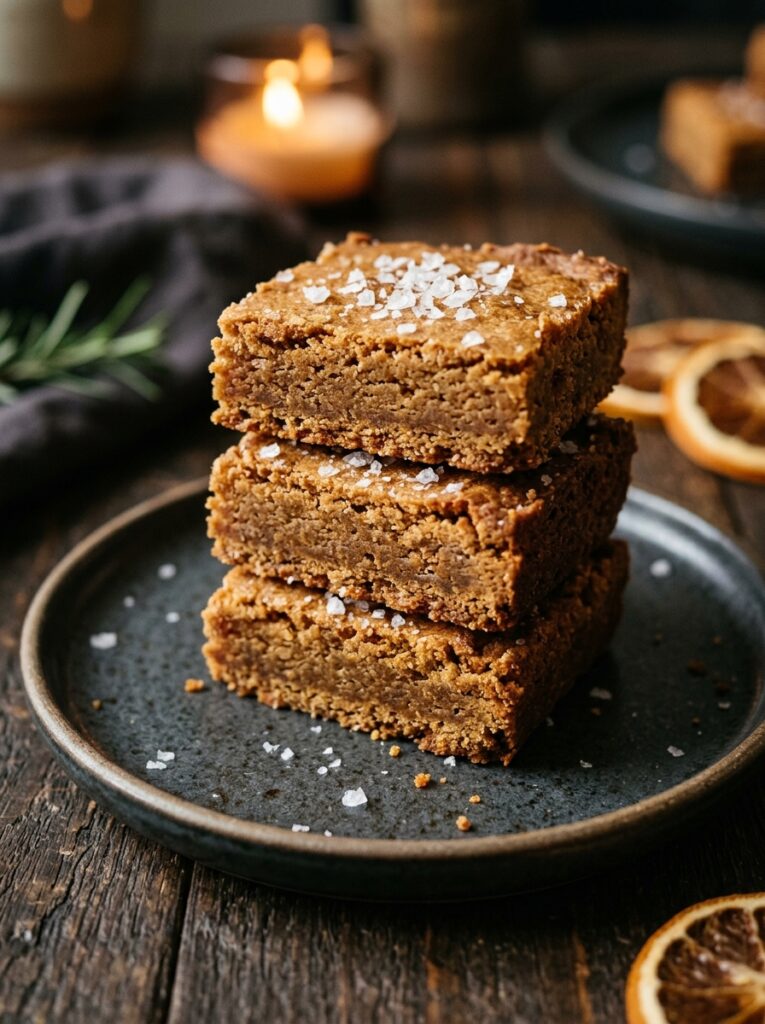
Brown butter is what happens when you cook butter past melting until the milk solids toast and turn golden — and the flavor shift is dramatic. The result tastes nutty, caramel-like, and deeply warm in a way that plain butter simply doesn’t produce. In shortbread, that flavor has nowhere to hide, which makes the brown butter version significantly more complex and interesting than the classic. This is the recipe to make when you want to impress someone who thinks they don’t like shortbread.
Ingredients
- 1 cup unsalted butter
- ½ cup powdered sugar, sifted
- 2 cups all-purpose flour
- 1 teaspoon vanilla extract
- ¼ teaspoon salt
- Flaky sea salt for topping
Instructions
- Brown the butter first: melt it in a light-colored saucepan over medium heat, stirring frequently, until the foam subsides and the solids turn golden and smell nutty — about 5 minutes. Pour into a bowl immediately and refrigerate until solid, at least 1 hour.
- Once solid, beat the brown butter with powdered sugar until just combined. Add vanilla and salt, then add flour and mix until the dough comes together.
- Press the dough into an even layer in a parchment-lined 8×8-inch pan. Score into fingers or squares with a sharp knife before baking — this makes clean cutting easier after they’re baked.
- Preheat oven to 325°F. Refrigerate the pan for 20 minutes while the oven heats.
- Bake for 22–26 minutes until the surface is matte and the edges are light golden. Sprinkle with flaky sea salt immediately out of the oven. Re-score the marked lines while still warm, then cool completely before breaking into pieces.
Recipe 6: Peppermint White Chocolate Shortbread

These are made for the holiday tray. White chocolate coating, crushed candy cane on top, and peppermint extract worked directly into the dough — every element signals Christmas without any elaborate decorating technique. The peppermint in the dough is subtle rather than overwhelming; the extract provides aroma and a cool finish rather than the intensity of a candy cane itself. Together with the white chocolate coating and the crushed candy cane crunch, each cookie delivers exactly what a holiday cookie should.
Ingredients
- 1 cup unsalted butter, cold, cubed
- ½ cup powdered sugar
- 2 cups all-purpose flour
- ¾ teaspoon peppermint extract (start with ½ teaspoon if you prefer subtle mint)
- ¼ teaspoon vanilla extract
- ¼ teaspoon salt
- 6 oz white chocolate, melted
- 1 tablespoon coconut oil
- 3–4 candy canes, crushed into small pieces
Instructions
- Beat cold butter and powdered sugar until just combined. Add both extracts and salt. Add flour and mix until the dough just forms a ball.
- Shape into a disc, wrap, and refrigerate for 30 minutes. Meanwhile, crush candy canes in a zip bag using a rolling pin until you have small, irregular pieces — not fine powder.
- Preheat oven to 325°F. Roll dough to ¼-inch thickness and cut into rounds. Place on parchment-lined baking sheets.
- Bake for 14–16 minutes until the edges are just golden. Cool completely before coating.
- Melt white chocolate and coconut oil together until smooth. Dip each cooled cookie to coat the top half, or spoon chocolate over the surface.
- Before the chocolate sets, scatter crushed candy cane pieces over each cookie. Let set fully on parchment before serving or stacking.
Recipe 7: Almond Vanilla Shortbread
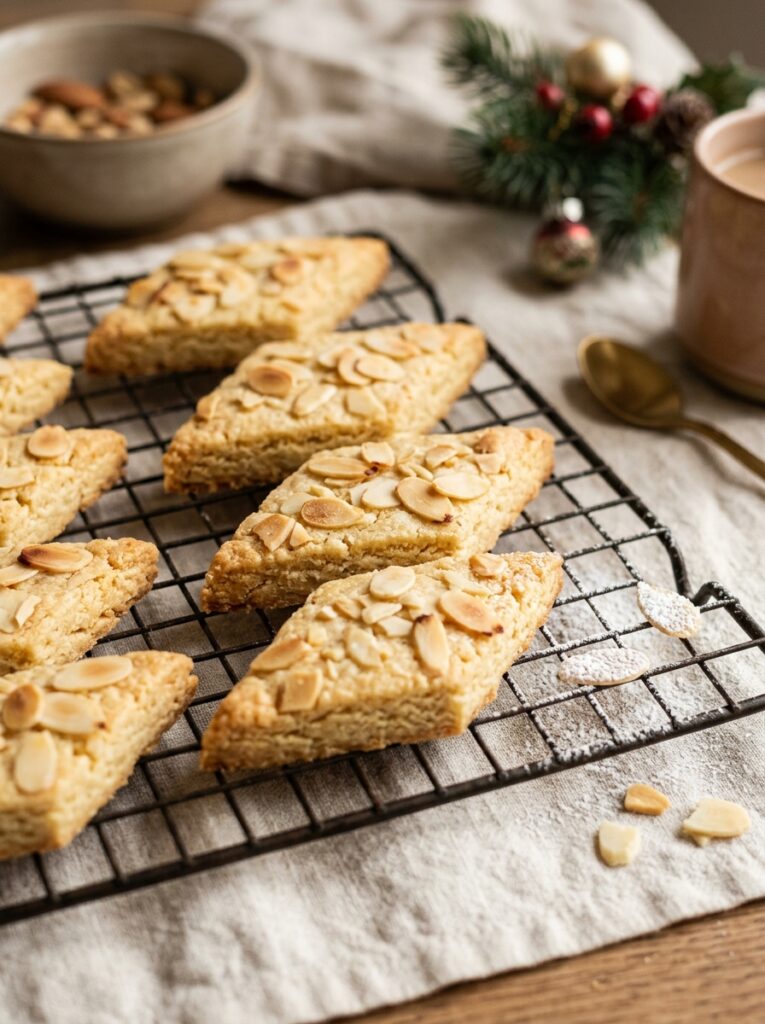
Almond extract in a butter cookie dough is one of those additions that makes the finished product taste more bakery-quality than homemade. It adds a faintly floral, marzipan-like note that works beautifully against the neutral richness of shortbread. Pressing flaked almonds into the surface before baking adds texture and a toasted visual element without any additional steps. These are among the most understated-looking cookies in this collection and consistently among the most quickly eaten.
Ingredients
- 1 cup unsalted butter, cold, cubed
- ½ cup powdered sugar
- 2 cups all-purpose flour
- 1 teaspoon almond extract
- ½ teaspoon vanilla extract
- ¼ teaspoon salt
- ⅓ cup flaked or sliced almonds for topping
- 1 egg white, lightly beaten (for brushing)
Instructions
- Beat cold butter and powdered sugar until just combined. Add both extracts and salt, then add flour and mix until dough forms.
- Wrap and refrigerate for 30 minutes.
- Preheat oven to 325°F. Roll dough to ¼-inch thickness and cut into diamond or rectangular shapes.
- Brush the surface of each cookie lightly with beaten egg white, then press 4–5 flaked almond pieces gently into the surface. The egg white acts as glue and also gives the surface a subtle shine after baking.
- Bake for 15–17 minutes until pale golden at the edges and the almonds are lightly toasted. Cool completely on the pan.
Recipe 8: Jam Thumbprint Shortbread
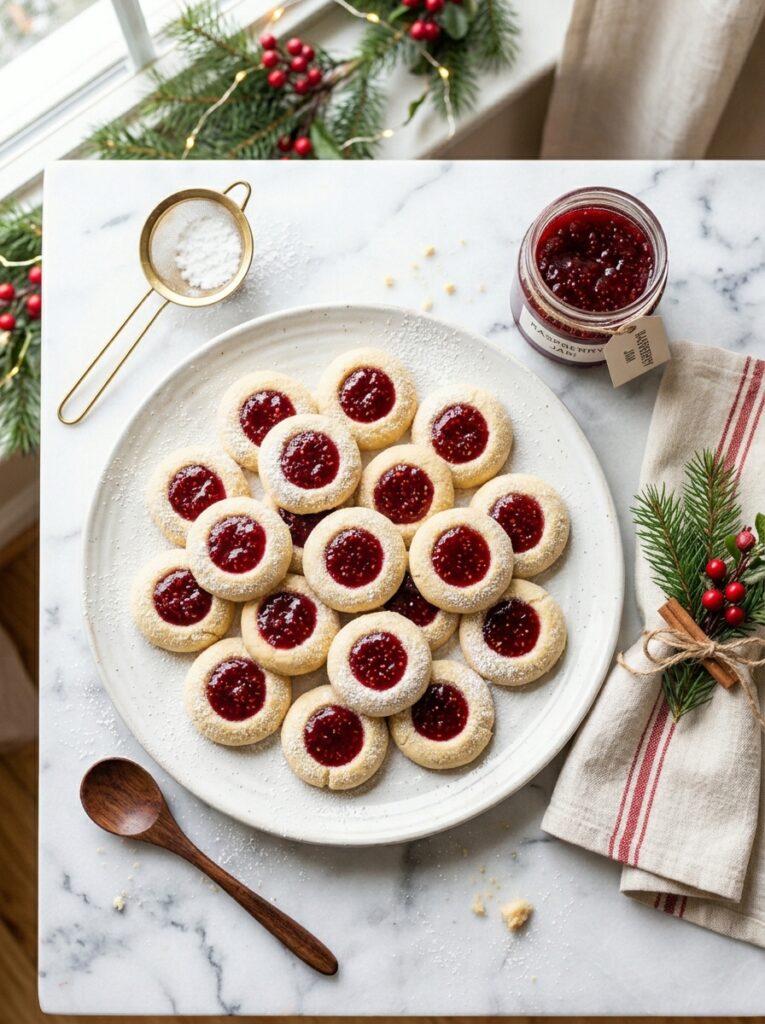
Thumbprint cookies and shortbread are a natural pairing because the buttery, crumbly base holds its shape during baking and creates a clean well for the jam filling. Raspberry jam is the traditional choice, but any preserve works — strawberry, apricot, blackberry, or a combination for a mixed tray. These are also the most beginner-friendly shape in the collection since they require no rolling pin or cookie cutters; a simple scoop and thumb-press is all it takes.
Ingredients
- 1 cup unsalted butter, cold, cubed
- ½ cup powdered sugar
- 2 cups all-purpose flour
- 1 teaspoon vanilla extract
- ¼ teaspoon almond extract (optional but recommended)
- ¼ teaspoon salt
- ⅓ cup raspberry jam (or jam of choice)
- Powdered sugar for dusting
Instructions
- Beat cold butter and powdered sugar until just combined. Add both extracts and salt, then mix in the flour until the dough just comes together.
- Roll the dough into 1-inch balls — no rolling pin required — and place 2 inches apart on parchment-lined baking sheets.
- Press your thumb or the round handle of a spoon firmly into the center of each ball to create a deep indent. Press slowly rather than quickly to avoid cracking the edges.
- Chill the shaped cookies on the baking sheet for 15 minutes while you preheat the oven to 325°F.
- Bake for 14–16 minutes until pale golden. As soon as the cookies come out of the oven, re-press each indent briefly while the dough is still warm — they always puff up slightly during baking.
- Once the cookies are fully cooled, fill each indent with ½ teaspoon of jam. Let the jam set for 10 minutes before dusting with powdered sugar.
I’ve noticed that warming the jam slightly before filling — just 15 seconds in the microwave — makes it flow into the indent more cleanly and creates a smoother, glossier surface once it sets. Cold jam from the jar can sit unevenly in the well.
Recipe 9: Eggnog Spiced Shortbread

Eggnog and shortbread turn out to be an excellent pairing because the natural richness of eggnog complements the butter base without making the dough too wet. A tablespoon of real eggnog replaces part of the vanilla, while nutmeg — the defining spice in eggnog — goes into both the dough and a simple eggnog glaze. The result is a cookie that tastes unmistakably like December without being as heavily spiced as a gingerbread, which makes it a welcome addition to a tray that already has a lot of strong flavors.
Ingredients
- 1 cup unsalted butter, cold, cubed
- ½ cup powdered sugar
- 2 cups all-purpose flour
- 2 tablespoons eggnog (real eggnog, not mix)
- ½ teaspoon vanilla extract
- ½ teaspoon ground nutmeg
- ¼ teaspoon cinnamon
- ¼ teaspoon salt
For the eggnog glaze:
- 1 cup powdered sugar
- 2–3 tablespoons eggnog
- Pinch of nutmeg for dusting
Instructions
- Beat cold butter and powdered sugar until just combined. Add eggnog, vanilla, nutmeg, cinnamon, and salt and mix briefly.
- Add flour and mix on low until the dough just comes together. It will be slightly softer than the classic dough due to the liquid eggnog — that’s expected.
- Wrap and refrigerate for 45 minutes until firm enough to roll.
- Preheat oven to 325°F. Roll to ¼-inch thickness and cut into rounds. Place on parchment-lined baking sheets and bake for 14–16 minutes until pale golden.
- Cool completely before glazing. For the glaze, whisk powdered sugar and eggnog together until smooth and drizzleable. Spoon over cooled cookies and spread to the edges.
- Dust lightly with ground nutmeg immediately after glazing, before it sets. Let the glaze firm up for 20 minutes before stacking or storing.
Tips for Best Results
Mastering the Dough
Don’t overwork the dough. Shortbread is fragile in a specific way — too much mixing develops gluten and turns what should be a tender, crumbly cookie into something dense and tough. Mix only until the dough just comes together. Small dry crumbs in the bowl are fine; they come together during shaping and chilling.
Measure flour correctly. Scooping the measuring cup directly into the flour bag compresses it and consistently over-measures by 20–30%. Instead, spoon flour into the cup and level it off with a straight edge. Too much flour makes shortbread dry and chalky.
Chill every time. Even if the dough seems firm enough to bake right away, 30 minutes in the fridge relaxes any gluten development, firms the butter, and produces cookies that hold their shape during baking. Skipping this step is the most common reason shortbread spreads into thin, uneven rounds.
Baking and Decorating
Use a light-colored baking sheet. Dark pans absorb more heat and overbrown the bottoms of shortbread before the surface has time to set. Light-colored aluminum is the most forgiving and produces the most even bake across all nine recipes.
Decorate only on fully cooled cookies. Chocolate coating, glazes, and jam fillings all behave differently on warm cookies — chocolate blooms, glazes run, and jam absorbs into the dough. Always wait until the cookies are completely at room temperature before any finishing steps.
Common Mistakes to Avoid
During Mixing and Chilling
Using room-temperature butter. Softened butter is standard for most cookies, but shortbread is an exception. Room-temperature butter makes the dough too soft to hold its shape, produces a greasier texture, and often results in flat cookies. Keep the butter cold and work quickly.
Over-chilling the dough until it’s rock hard. There’s a sweet spot — dough chilled for 30–60 minutes rolls and cuts cleanly. Dough left overnight without plastic wrap becomes so firm it cracks at the edges when rolled. If your dough is too cold, let it sit at room temperature for 5–10 minutes before rolling.
During Baking
Pulling cookies from the oven too early. Shortbread should look almost underdone when done correctly — pale gold at the edges, matte surface, no browning in the center. Since the cookies firm up as they cool, they’ll feel soft right out of the oven. Leaving them on the hot pan for 5 minutes completes the cooking gently without overbrowning.
Moving cookies before they’re cool. Shortbread is structurally fragile when warm. Moving it too soon causes breakage. Let it cool fully on the pan — at least 10 minutes for thin cookies, 15–20 minutes for thicker pan shortbread.
Variations
Flavor Add-Ins
Matcha: Add 1½ teaspoons of culinary-grade matcha powder to the base dough. The result is an earthy, slightly bitter green tea cookie that looks striking with a white chocolate dip. This variation pairs particularly well with the almond extract version.
Espresso: Mix 1 teaspoon of instant espresso powder into the flour before adding to the butter mixture. The coffee flavor is subtle rather than dominant — it enhances the buttery richness without tasting like a mocha. Excellent alongside dark chocolate dipping.
Lavender: Add ½ teaspoon of culinary lavender (finely ground) to the dough with the vanilla. Since lavender can become soapy at higher amounts, less is more. A simple lemon glaze on top completes the floral flavor nicely.
Dietary Swaps
Dairy-Free: Replace butter with a high-quality plant-based butter (Miyoko’s or Kerrygold-style vegan varieties work best). The dough behaves nearly identically and the flavor difference is minimal. Avoid margarine, which has too high a water content for shortbread.
Gluten-Free: Substitute a 1:1 gluten-free flour blend for the all-purpose flour. The texture will be slightly more crumbly, so handle the dough gently and allow extra chilling time. These also benefit from pressing rather than rolling.
Storage and Make-Ahead Guide
| Storage Method | Container | Duration | Key Notes |
|---|---|---|---|
| Room temperature (baked) | Airtight tin or container | Up to 2 weeks | Best flavor days 2–5; layer with parchment |
| Refrigerator (baked) | Airtight container | Up to 3 weeks | Bring to room temp before serving |
| Freezer (baked) | Zip freezer bag, parchment between layers | Up to 3 months | Thaw at room temperature 30 minutes |
| Freezer (unbaked dough log) | Wrapped in plastic, then foil | Up to 3 months | Slice from frozen; add 2–3 extra bake minutes |
| Freezer (unbaked cut shapes) | Flat on parchment, then transferred to bag | Up to 3 months | Bake directly from frozen without thawing |
| Decorated/glazed cookies | Airtight single layer | Up to 5 days | Stacking damages glaze; store flat or use parchment dividers |
Best make-ahead method: Shape the dough into a log before freezing. When you want fresh shortbread, pull the log from the freezer, let it soften for 5 minutes, slice into rounds, and bake directly. The slice-and-bake method is the most practical approach for holiday baking when you want freshly baked cookies without starting from scratch each time.
FAQs
Why is my shortbread spreading flat in the oven? Almost always one of two things: the butter was too soft, or the dough wasn’t chilled before baking. Even if you’re in a hurry, 30 minutes in the fridge is non-negotiable for shortbread that holds its shape. If it still spreads, try reducing the butter by one tablespoon and chilling for a full hour next time.
What makes shortbread crumbly rather than tender? Too much flour or not enough butter. Both issues usually trace back to measurement — specifically, scooping flour directly with the measuring cup rather than spooning it in. Also, refrigerating the dough too long without wrapping it causes the outside to dry out, which produces a crumbly, uneven texture.
Can I use salted butter for shortbread? Yes, but reduce or eliminate the added salt in the recipe. Salted butter produces a slightly more complex flavor that many people actually prefer. The main downside is that salt content varies by brand, so results can be inconsistent if you switch butter brands between batches.
How do I get clean edges when cutting shortbread? Use a sharp knife or cookie cutter dipped in flour between cuts. Also, make sure the dough is well-chilled before cutting — warm dough compresses at the edges and produces rounded rather than sharp shapes. For log-style shortbread, refrigerating for at least an hour before slicing produces cleaner rounds.
Can I make shortbread without a mixer? Yes. Rub cold butter into the flour and sugar mixture with your fingertips until it resembles coarse crumbs, then press and knead gently until a dough forms. This method actually gives you more control over the mixing process and is the traditional approach before electric mixers were common.
How long should I bake shortbread? At 325°F, most ¼-inch shortbread takes 14–17 minutes. The correct doneness looks pale gold at the edges with a completely matte surface — not shiny, not browned in the center. Since every oven is different, check your first batch at 13 minutes and adjust from there.
Conclusion
Nine recipes, one base dough, and enough variety to fill every gift tin and holiday tray from Thanksgiving through New Year’s. Christmas Shortbread Cookies are worth making because they reward the small amount of attention the technique requires with results that genuinely taste homemade in the best sense — buttery, delicate, and better than anything from a box.
Start with the classic butter version to learn how the dough should feel and how your oven handles the timing. After that, any of these eight variations feel straightforward. Save this guide to your Pinterest holiday baking board so you have it when December arrives, and share a photo when your tray comes together — these are the kind of cookies people remember.